

NASA Satellite Reenters Earth After Years Studying Radiation Belts
A NASA spacecraft that spent more than a decade studying Earth’s radiation environment has made its fiery return to the planet. Van Allen Probe A, a 1,300-pound (about 600-kilogram) satellite launched in 2012, reentered Earth’s atmosphere in March 2026 after nearly 14 years in orbit.
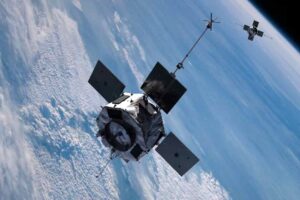
The spacecraft was part of NASA’s Van Allen Probes mission, which aimed to better understand the radiation belts surrounding Earth—regions filled with high-energy charged particles trapped by the planet’s magnetic field.
Scientists say these radiation belts play a crucial role in shielding Earth from harmful cosmic radiation and solar storms.
Earlier-Than-Expected Reentry Due to Solar Activity
Originally, NASA predicted that the spacecraft would stay in orbit until around 2034. However, intense solar activity during the current solar cycle expanded Earth’s atmosphere and increased drag on the satellite, causing it to descend faster than expected.
As a result, the probe’s orbit gradually decayed, leading to its earlier-than-planned reentry in March 2026.
Most of the Spacecraft Burned Up
NASA and the U.S. Space Force tracked the spacecraft’s descent and predicted it would reenter the atmosphere around 7:45 p.m. EDT on March 10, with a possible timing uncertainty of about 24 hours.
During reentry, most of the spacecraft was expected to burn up due to the extreme heat generated while passing through Earth’s atmosphere. However, a few components could potentially survive and reach the surface.
Despite that possibility, NASA estimated the chance of debris harming anyone on the ground to be extremely small—about 1 in 4,200.
A Mission That Exceeded Expectations
The Van Allen Probes mission included two spacecraft—Probe A and Probe B—launched together on August 30, 2012. Initially designed for a two-year mission, the satellites continued collecting valuable scientific data for nearly seven years before the mission ended in 2019.
The probes made several groundbreaking discoveries about how radiation particles behave around Earth, including the discovery of a temporary third radiation belt during periods of intense solar activity.
These findings have helped scientists better understand space weather and how solar storms can affect satellites, astronauts, communication systems, navigation networks, and even power grids on Earth.
What Happens Next?
While Van Allen Probe A has now reentered Earth’s atmosphere, its twin spacecraft, Probe B, remains in orbit and is not expected to reenter until around 2030 or later.
Even after the mission’s end, data collected by the Van Allen Probes continues to support research into space weather forecasting and the protection of space technology.